Professional translator, educator, and owner of The Detail Woman, LLC. I love opportunities to both teach and learn from others, whether at large conventions or in smaller informal settings. My not-so-secret passions are research, terminology management, and penguins.
LinkedIn | Twitter
Welcome to the holidays: a season full of good food, wonderful concerts, and crazy, epic stress.
Many translators and other computer-based workers are chained to our desks, muscles tight, practically vibrating with the stress of December’s usual insane deadlines. Me, I’m freaking out a little more every time I look at my email accounts… the business one or the personal one.
Maybe we’re managing our stress with exercise, as this blog has discussed before, or maybe we’re using another coping method, or maybe we’re just choosing to fling ourselves recklessly into the void. Hey, I’m in no place to judge. But I think most of us are probably experiencing some seasonal increase in stress.
Unfortunately, with stress often comes pain.
So, today I’d like to share my simplest pain control technique–something that regularly helps me both at my desk and while I’m standing on one leg in the yoga studio. It’s simple, you can do it sitting down, and all you need is 20 seconds and the tongue in your mouth.
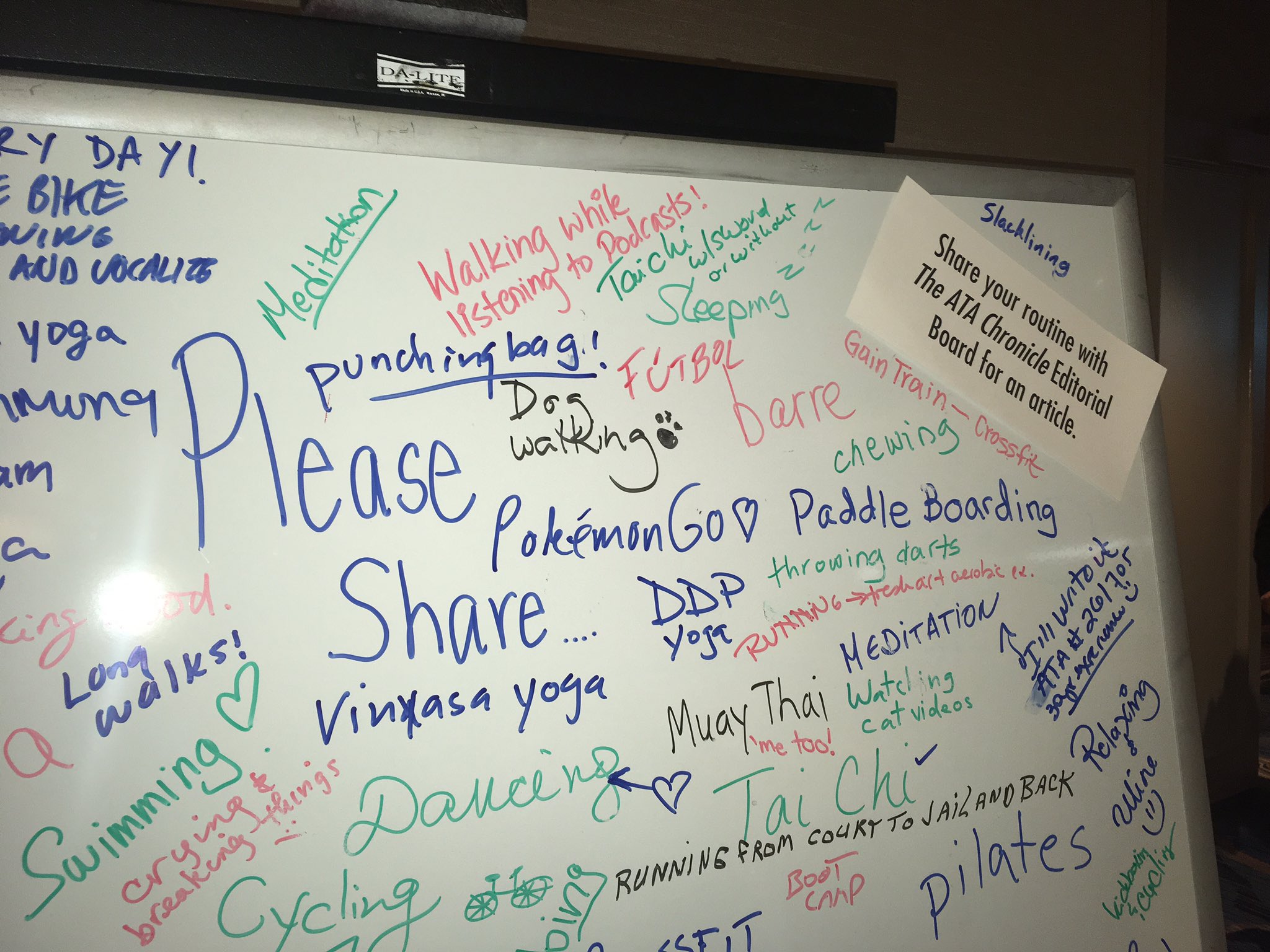
Photo by me at the 2018 American Translators Association conference.
The whiteboard pictured above made its appearance at this year’s American Translators Association conference, and it kept us entertained all weekend long:
As you can see, a lot of us weighed in. There are many gems in there–I’m partial to the one about running from court to jail and back–but the whole thing got me thinking about how this is a really important question. How do we stay healthy and manage our stress?
The number of serious responses both on the whiteboard and on Twitter clue us in to the fact that exercise really does work:
My productivity definitely went up when my physical therapy started including regular exercise. The time it takes us much less than the time gained through the increased energy. https://t.co/hheiMvadeH
We’re all different, but we all need to get this whole fitness thing done somehow. So I figured I’d share the set of tools I personally use to get the job done. Here we go…
Today I have something fantastic to announce: the first “S&N (Sarah & Nadine) Financial Independence Series” publication by my sister in planning, Nadine Edwards! This series is a collaborative effort to help translators and other freelancers escape the fight-or-flight response to money issues by starting conversations and providing tools address our needs. It started with … Read more
I’m writing this from New Orleans, replete with local food, watching the riverboats and unwinding after the American Translators Association’s annual conference. No, I’m not just trying to make you jealous. This is all relevant information, I promise. The ATA conference is fun and productive every year, but this year one of my favorite moments … Read more
Right Stuf is having another sale, this time for Memorial Day. Please keep in mind, only DVDs are on sale this time. So, if you want to purchase on Blu-ray, you may just want to add these to your wish list and wait for a Blu-ray sale.
And without further ado, here are some more recommendations from various genres:
*Note: The views expressed in this essay are the author’s alone, and should not be taken to represent the views of any current or former employers.
When I read Uma Thurman’s stories of abuse and betrayal at the hands of the men who were supposed to be her collaborators, I couldn’t help but write about it. Something about the context of experiencing these terrible things while she was working on Kill Bill, one of the most violent cinematic environments possible (even if she and her stunt double were often the ones instigating the violence), struck a familiar chord with me.
I work in the entertainment industry, translating films and TV shows. I translate mostly TV, but I love film. Film is my greater love, and it’s where I wish I spent more of my time. But I’ll tell you something: Despite my profession, in my private life, that love died for a long time. I stopped watching films for years.
It wasn’t “despite” my profession. It was because of my profession.
I’ve never been sexually assaulted or put in extreme physical danger in the name of film, like Thurman and so very many of her colleagues. I don’t claim the #MeToo hashtag for myself, because it belongs to those who have experienced things I haven’t. But the juxtaposition of “my day job” with “horrific sexual violence” is familiar to me. I think it’s probably familiar to far more people than those outside the industry might imagine.
That’s why today, I want to talk about the entertainment industry. Not because it’s the only industry that is home to male sexual predators—it isn’t. Not because the suffering of entertainers matters more than other people’s suffering—it doesn’t. Not even because this is the worst of work environments for a language professional—that’s not true, either. (I can’t imagine what it’s like to be a court interpreter, hearing and relating the stories of crime victims.) But because it’s a work environment that’s not easy for many people to understand, and that’s something I can help with.
So, here are some thoughts on being a woman in the entertainment world.
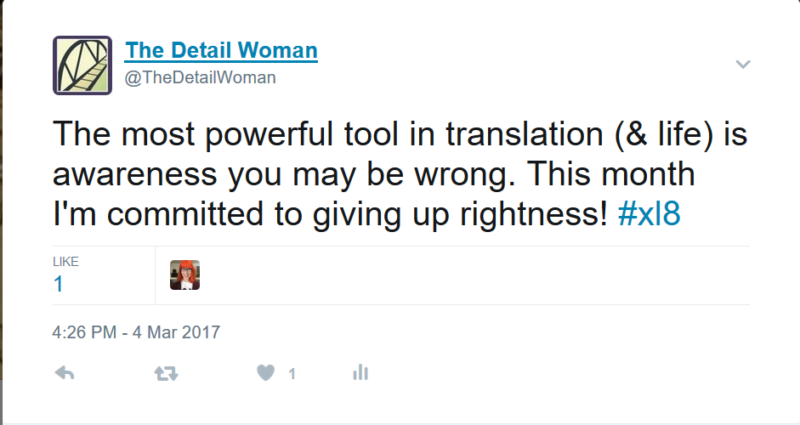
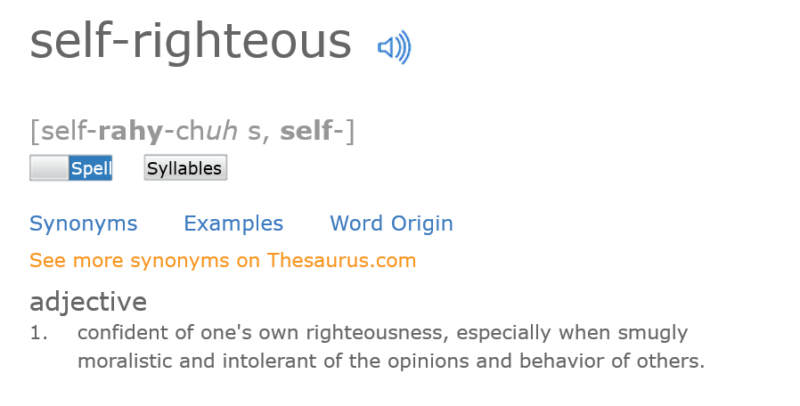
More concretely, I decided to give up being right for Lent. I was motivated by several different things, both abstract and pragmatic. There was my frustration with what I see as a potentially fatal barrier to productive discourse in American society today—widespread self-righteousness—and my desire to change it. There was my interest in how philosophical concepts like self-doubt and self-righteousness interact with religion. And there was my identity as a translator.
Wait, you may be thinking, what does being a translator have to do with any of this?
Well, I’m glad you asked! This is a translation blog, after all. And my view is that a healthy, consciously wielded self-doubt sits squarely at the heart of the translator’s best practices.
Less than a year after I turned translation from my hobby into my profession, I was put in charge of reviewing other anime translators’ work. I was so young—just 23!—and so unestablished that this was a pretty shocking development. I mean, I knew translation was the career for me, but I didn’t think I’d already achieved unparalleled genius in the field or anything. I’m sure that if any of the people whose work I was correcting back then learned my age, they were quite shocked too, if not actively offended.
As it turned out, the fact that I didn’t think I’d achieved genius is exactly what made me a good reviewer. In the beginning, when I looked at a translation of anything more complex than sentences like “Please” and “Thank you,” I’d try to verify, because I didn’t trust my own authority over the other translators’ in any inherent way. I looked up words. I looked up all the words, including the words I already knew. I reread my grammar books to make sure I wasn’t misremembering obscure usages. I asked my mentor when I wasn’t sure I’d figured something out correctly. And I rapidly discovered that this is exactly what the people whose work I reviewed weren’t doing, and therefore the work was riddled with errors. And so I learned that the self-doubt I felt wasn’t just “beginner’s jitters” that more time in the career should alleviate. Instead, it was the most powerful tool a translator can have at her disposal. When we know how easily we can be wrong, we take the steps to try to be less wrong. It might take a few days of bravery to really internalize that you’re constantly teetering on the edge of wrongness, but once you get there, it’s not only empowering: it’s an enormous relief.
You can’t be both a good translator and a self-righteous translator. It’s just not a thing.
Human fallibility, on the other hand, is definitely a thing.
So in the last couple of years, as I’ve seen self-righteousness overcome more and more of society in our religious, political, and social conversations and realized how little we are willing to listen to each other from that place of “healthy, consciously wielded self-doubt” so that we can truly understand and solve problems, the more I’ve thought that this wrongness principle should apply outside of translation. It should apply to our lives across the board: humans are fallible, which means we could be wrong in our convictions at any time. My premise, then, at the beginning of my Lenten experiment was, “You can’t really see the truth about anything until you acknowledge that you might not have looked at it properly yet.”
Since I want to see everyone practice this, I started by trying to practice it myself. I wrote several friends-only follow-ups on Facebook throughout Lent, and promised to write up my notes on the whole experience at the end… which is what I’m doing now.
Many of us translators work with clients who have very specific privacy requirements. If we don’t start our projects exactly right for those requirements, it can be quite time-consuming to fix everything individually later. But I’m happy to report that I’ve found a great solution for changing commenter names, so I’d like to share it … Read more
Thank you to all the attendees who came to my “Leveling Up” presentation at IJET-27! You were a great audience, and I loved hearing your comments afterward. As promised, here is the PDF of my PowerPoint slides. If you attended and you have suggestions for how I could improve the session, please feel free to … Read more
Cookie Consent
We use cookies to improve your experience on our site. By using our site, you consent to cookies.
Contains information related to marketing campaigns of the user. These are shared with Google AdWords / Google Ads when the Google Ads and Google Analytics accounts are linked together.
90 days
__utma
ID used to identify users and sessions
2 years after last activity
__utmt
Used to monitor number of Google Analytics server requests
10 minutes
__utmb
Used to distinguish new sessions and visits. This cookie is set when the GA.js javascript library is loaded and there is no existing __utmb cookie. The cookie is updated every time data is sent to the Google Analytics server.
30 minutes after last activity
__utmc
Used only with old Urchin versions of Google Analytics and not with GA.js. Was used to distinguish between new sessions and visits at the end of a session.
End of session (browser)
__utmz
Contains information about the traffic source or campaign that directed user to the website. The cookie is set when the GA.js javascript is loaded and updated when data is sent to the Google Anaytics server
6 months after last activity
__utmv
Contains custom information set by the web developer via the _setCustomVar method in Google Analytics. This cookie is updated every time new data is sent to the Google Analytics server.
2 years after last activity
__utmx
Used to determine whether a user is included in an A / B or Multivariate test.
18 months
_ga
ID used to identify users
2 years
_gali
Used by Google Analytics to determine which links on a page are being clicked
30 seconds
_ga_
ID used to identify users
2 years
_gid
ID used to identify users for 24 hours after last activity
24 hours
_gat
Used to monitor number of Google Analytics server requests when using Google Tag Manager
1 minute
Google Tag Manager simplifies the management of marketing tags on your website without code changes.
Name
Description
Duration
cookiePreferences
Registers cookie preferences of a user
2 years
td
Registers statistical data on users' behaviour on the website. Used for internal analytics by the website operator.