
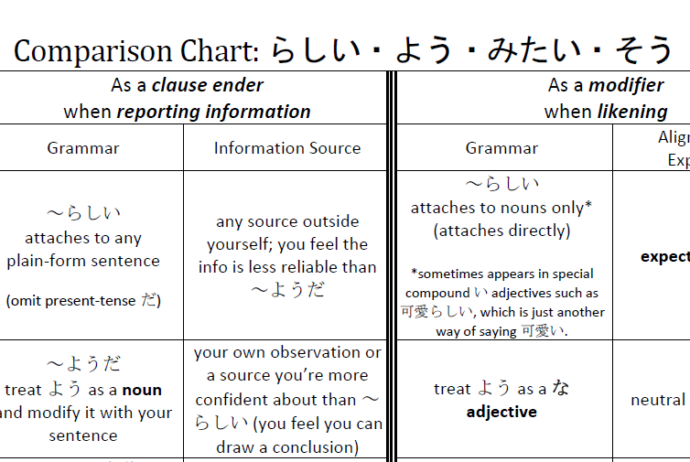
My students often struggle to find good explanations of the differences in nuance between the various “hearsay” constructions in Japanese: らしい, よう, みたい, and そう. This is the chart I’ve created to lay out the differences for them.
Another big struggle for most Japanese learners is that らしい, よう, みたい, and そう also have different grammatical usages where they function as “likeners” (modifiers expressing that one thing is like another)… but textbooks often teach the “likener” versions in a separate chapter, leading students to get confused about which grammar goes where. The “likeners” are also in this chart, along with a breakdown of the differences between them.
This packet contains a 5-page .pdf with the chart on one page for handy printing. The remaining four pages are examples of each hearsay word and likener.
A .docx version is included with the .pdf download.